

An aviation enthusiast since childhood, I follow the evolution of air transport worldwide with great interest. Through Uspassengers.com, I focus on analyzing the latest news from American airlines and all carriers operating to and from the United States: new routes, fleet renewals, inter-company agreements, airport developments, and more.
United Airlines revises its policy on carrying batteries in hand luggage.
For an executive constantly on the move or a vlogger documenting their journey right from the boarding gate, slipping a portable battery into a bag is almost second nature: it keeps the phone running between meetings, powers the laptop during long layovers, and ensures reliable connections for impromptu video calls in airport lounges. It is precisely this small, seemingly mundane object that now lies at the heart of a rule change at United Airlines.
Batteries can no longer be stowed in overhead bins
Since March 1st, United has required that spare batteries and e-cigarettes remain with the passenger at all times or be kept in a personal item stowed under the seat in front of them. Storing them in overhead bins is no longer permitted. The airline’s stated goal is simple: in the event of a lithium battery overheating, the crew must be able to intervene within seconds, something impossible if the device is locked away several feet above the seats.
This decision did not come out of nowhere. It is part of a broader trend among major US carriers, such as Southwest, American, Delta, JetBlue, and Alaska, all of which are simultaneously tightening internal protocols regarding incidents involving lithium-ion batteries on board. International civil aviation authorities have also been pushing for this measure for several months, following a series of documented overheating incidents in the cabin.
What remains unchanged:
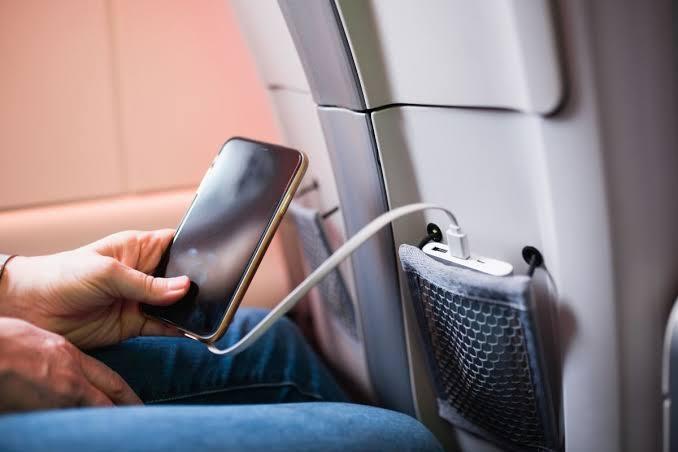
Beyond this new rule regarding where items must be stowed, the key principles established by US federal regulations remain the foundation of United’s battery policy:
No spare batteries in checked luggage: Any lithium-ion battery not installed in a device must travel exclusively in the cabin. A 100 Wh threshold with no formalities: Below this limit, no prior authorization is required.
For capacities between 100 and 160 Wh, airline approval is required; this is generally limited to two spare batteries per passenger.
Terminals must be protected against short circuits, for example, by using a plastic bag, the original cap, or electrical tape over exposed contacts.
Recharging the power bank itself during the flight is prohibited; while using it to power a phone is allowed, recharging the power bank is not.
For passengers traveling with multiple devices, such as a laptop, tablet, or smartphone, the focus is less on prohibitions and more on accessibility and the declaration of high-capacity equipment.