
On JetBlue, every traveler can bring two items on board: a carry-on bag for the overhead bin and a personal item that fits under the seat in front. This rule applies regardless of the fare chosen, but with one major caveat: access to the overhead bin depends on available space on the day of the flight.
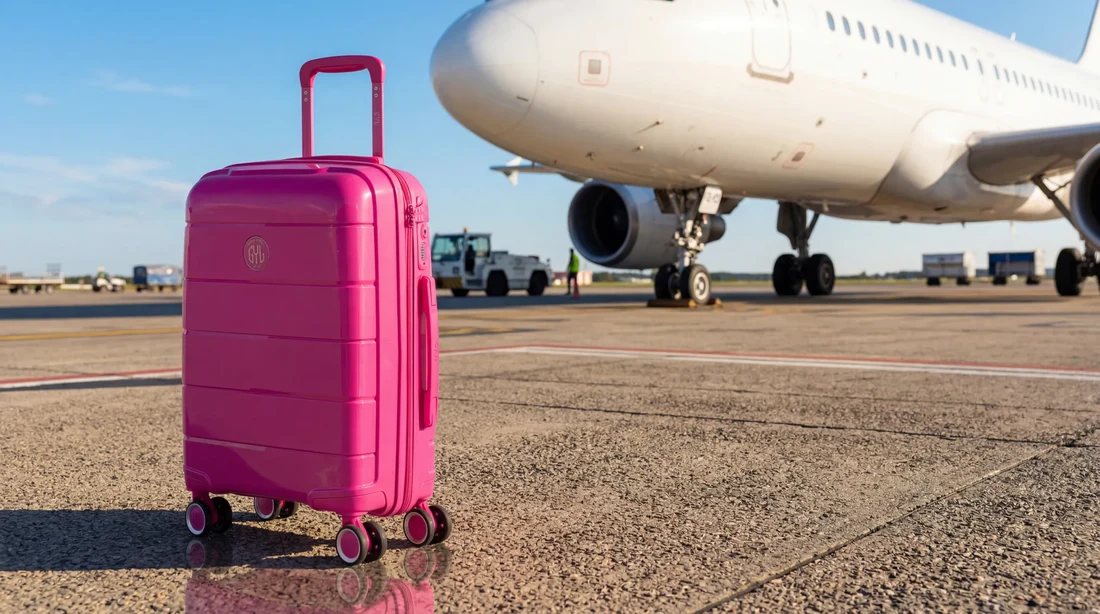
Size and weight limits
|
Item |
Length | Width |
Height |
|
Cabin baggage |
22 in (56 cm) | 14 in (36 cm) | 9 in (23 cm) |
| Personal article | 17 in (43 cm) | 13 in (33 cm) |
8 in (20 cm) |
Important: for carry-on luggage, the measurement includes anything that protrudes from the shell, namely, the wheels and handles.
And what about luggage weight?
Unlike checked baggage, which is subject to weight limits (generally 50 pounds, or about 23 kg, with fees for exceeding the limit), JetBlue carry-on bags have no official weight limit. The same applies to personal items.
There is just one common-sense requirement: you must be able to lift your bag into the overhead bin on your own if no one is available to help you.
What to pack as carry-on luggage?
In the overhead bin: a small wheeled suitcase or a soft-sided travel bag that fits within the size limits.
Under the seat: a handbag, backpack, laptop bag, or compliant pet carrier.
The item must fit entirely under the seat in front of you, without protruding into the aisle or obstructing your legs.
Liquids in carry-on luggage
What is the 100 ml rule?
When departing from US airports, security screening applies the “3-1-1” rule: each container of liquid, gel, cream, paste, or aerosol must hold a maximum of 100 ml (3.4 oz); all containers must fit into a single, clear, resealable bag with a capacity of approximately one liter (one US quart); and each passenger is allowed only one bag.
A 150 ml bottle that is half-empty is still a 150 ml bottle: it is the container’s capacity that matters, not how full it is. Anything exceeding the limit must be checked in or left behind.
Note: Some airports equipped with the latest-generation scanners are testing more relaxed rules. Do not count on this; assume the 100 ml limit applies unless signage at your airport indicates otherwise.
Exceptions to the limit
Certain products are permitted in quantities exceeding 100 ml, provided the amount is reasonable for the duration of the trip:
• prescribed liquid medications or those deemed medically necessary;
• baby formula (powdered or ready-to-drink), breast milk, and drinks or juice intended for a baby or young child;
• baby food, including pouches of purée and jars;
• cooling packs used to keep breast milk, formula, or medication cold;
• duty-free purchases, provided they remain in their original sealed bag.
Traveling with a baby:
Rules are more flexible for parents, but they do require some organization:
• No fixed volume limit. You must keep the quantity reasonable relative to the length of the journey, including potential delays.
• You do not need to have the child with you to transport breast milk.
• Declare these items before going through security. Remove them from your bag, separate them from your other liquids, and point them out to the security officer. They may be subject to additional screening or testing, and the officer may ask you to open a container.
• Frozen or chilled breast milk: ice packs are permitted—even if partially melted—provided they are being used to keep these products cool.
• Powdered formula: as a solid, it is not subject to the liquids rule; however, large quantities of powder may trigger additional screening.
• Water for preparing bottles: declare this to the officer as well, as it is treated as a liquid necessary for the child.
• Small glass jars of baby food: permitted, though they may undergo more extensive inspection.
A practical tip: pack all baby essentials in a pouch that is easy to remove and place at the top of your personal item, so you don’t have to rummage through your bag in front of the waiting line.
Prohibited items in carry-on luggage
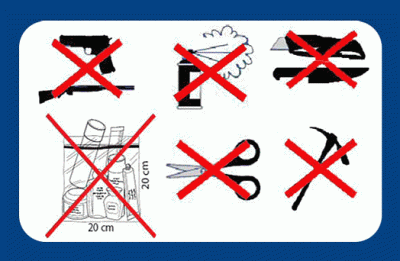
The official list is long and subject to change. Here are the main categories to be aware of to avoid having an item confiscated at security or facing penalties.
Weapons and sharp objects
Firearms, ammunition, gunpowder, and fireworks: strictly prohibited in the cabin. Firearms may only travel in the hold; they must be unloaded, packed in a locked hard-sided case, and declared to the airline.
Knives of any length, including pocket knives: The only exceptions are round-tipped, non-serrated cutlery, such as butter knives:
• Utility knives (box cutters), unprotected razor blades, and ice picks.
• Tools such as drills, saws, and electric screwdrivers.
• Self-defense items like pepper spray; these are only permitted in checked baggage, subject to current regulations.
Explosives and hazardous materials
Explosives, detonators, grenades, flares, and realistic replicas of explosive devices:
• Prohibited in both the cabin and the hold.
• Fuels, flammable products, compressed gas cylinders, and corrosive chemicals are not permitted on the aircraft.
Batteries and electronic devices
Here is the key exception: spare lithium batteries and external batteries (“power banks”) are prohibited in the hold and must be carried in the cabin with you:
• Standard limit for a lithium-ion battery: 100 Wh. Anything above this requires airline approval.
• Protect the terminals of spare batteries (using original packaging, tape over the contacts, or a dedicated pouch) to prevent short circuits.
• Do not bring damaged or swollen batteries on board.
• If your carry-on bag is moved to the hold at the last minute, remove any batteries and external chargers before handing it over.
What to do:
The provided list may not cover everything. If you are unsure about an item, consult the dedicated page on the U.S. Transportation Security Administration (TSA) website, which offers an item-based search tool, or check with JetBlue customer service before departure.